Progress claims
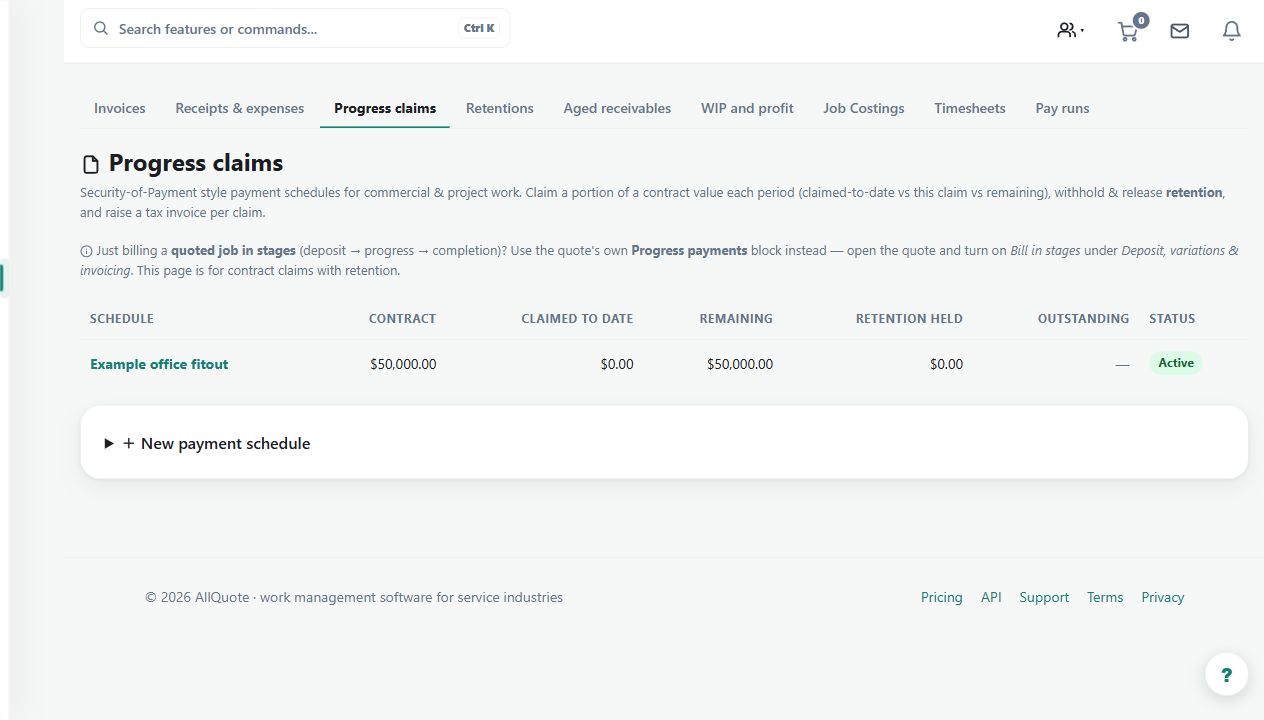
Tracks cumulative work claimed against a contract value and raises the matching progress invoice without losing earlier claims.
Use cumulative progress claims when billing follows completed contract value over successive claim periods.
Before you start
Availability: Team plan and above. Enabled business features, role permissions, connected providers and supported devices may add requirements.
Documented roles: Owner, Office. A role name alone does not override the permissions set by your business.
Where to find it: Money > Progress claims.
Prepare the contract value, claim schedule, prior claims and applicable retention arrangement. Confirm the customer and job before creating the schedule.
Using this guide in United States
- Set your business country in Business settings before entering customer addresses or preparing documents. The country selected on the public website does not change an existing business.
- Check the business currency (USD), time zone and document tax settings. Only enable tax collection if your business is registered and the settings match your requirements. Your customer invoice tax settings are separate from tax on your AllQuote subscription.
- Screenshots use demonstration records. Their sample currency, addresses and tax amounts do not override your business settings.
Step by step
- Open Progress claims and create a claim schedule for the customer, job and contract value.
- Add the claim stages or claim-to-date figures, then check the amount for this claim, retention and remaining value.
- Issue the claim invoice only after the cumulative totals and customer details are right.
- For a later correction, return to the claim schedule so the issued claim stays in the history and the next claim carries the adjustment.
Worked example
If an illustrative contract has $30,000 cumulative work claimed and $20,000 previously claimed, reconcile the new claim's $10,000 difference before retention, tax or other supported adjustments.
This is an illustrative scenario. Use your own approved scope, quantities, rates and business rules.
Check the result
Check claim-to-date, this-claim amount, previous claims, retention and remaining contract value. Inspect the generated invoice before issue.
Limits and troubleshooting
Claim certification state and invoice payment are different records. Correct later periods through the claim schedule so history remains traceable; do not treat an approved claim as proof that its invoice is paid.
Check current plans and feature availability · Browse every guide