Retention registers and release records
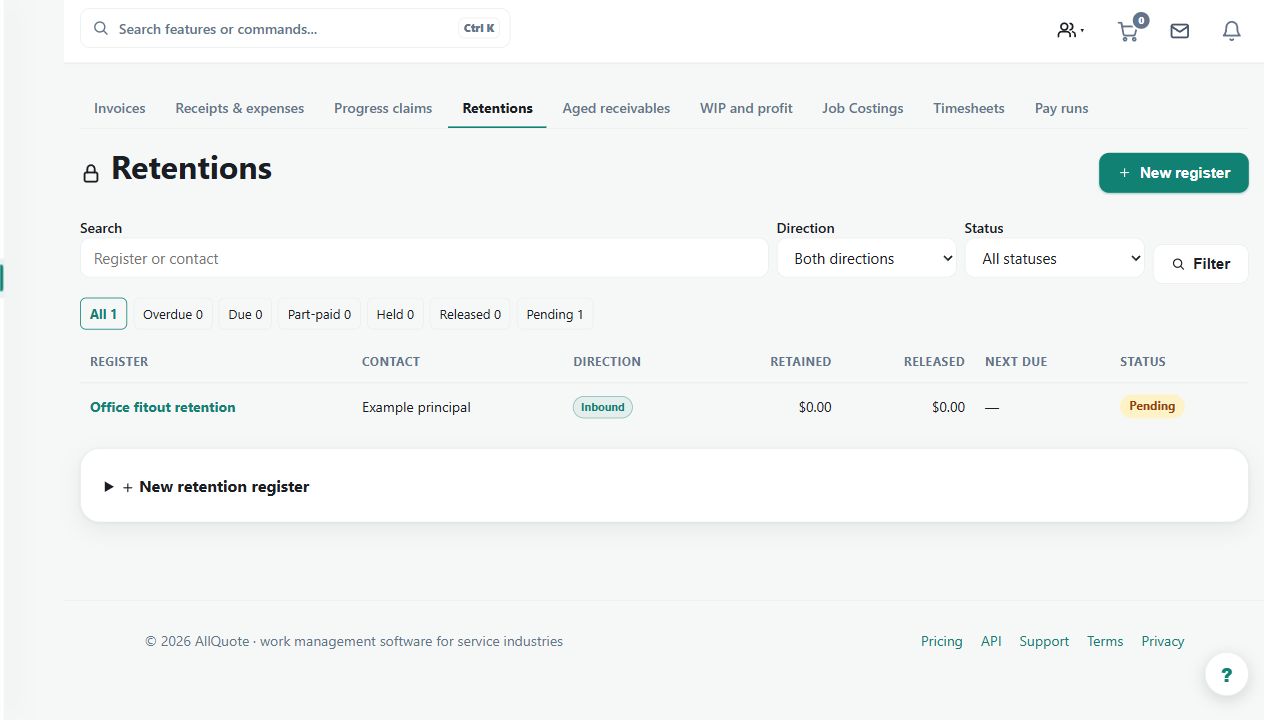
AllQuote records retention holds, adjustments and releases in registers linked to the relevant job and counterparty. The register keeps the balance and agreed release rules visible instead of leaving them only in invoice notes.
Published by AllQuote. Product information reviewed 18 October 2026. Examples use demonstration scenarios, not customer testimonials or promised results.
Can I track money held back and its later release?
AllQuote records retention holds, adjustments and releases in registers linked to the relevant job and counterparty. The register keeps the balance and agreed release rules visible instead of leaving them only in invoice notes.
- Plans
- Team, Business and Enterprise, with accounting enabled.
- Platform and access
- Business owner access in the web accounting workflow. Inbound and outbound directions must be selected correctly.
How the workflow fits together
Record the agreement
Choose the counterparty, direction, linked job and release conditions.
Track the balance
Review hold and adjustment events against the supporting contract and claim records.
Record release
Use the configured release rules, check the remaining balance and reconcile actual settlement separately.
A worked example
Illustrative balance: a hold of 5,000 followed by a release of 2,500 leaves 2,500 retained, before any other adjustments. A recorded release does not prove that the customer has transferred the money.
Requirements and limits
Release-and-invoice is a narrower flow: inbound retention linked to a claim schedule at practical completion. Not every register or release event can create an invoice. Check contract conditions and accounting treatment.
Plan access does not replace user permissions. Check local availability, enabled features and connected services for your business in New Zealand.
What to check in a demonstration
Create a sample hold, inspect its release conditions, record an eligible partial release and reconcile the remaining balance to the event history.